Choosing the best Digital Calendar Clock manufacturers in China takes more than comparing prices and catalog photos. A bright display can look impressive online yet become uncomfortable beside a bed. Small weekday labels can also frustrate someone reading across a room. Details matter. For buyers serving older adults, practical priorities include readable text, clear date formats, simple controls, and dependable alarms. The right supplier should demonstrate these features through working samples and clear technical documentation.
Industrial designer Dieter Rams offered a principle relevant to this category: “Good design is as little design as possible.” His words provide a useful lens for evaluating a Digital Calendar Clock, especially when extra functions complicate everyday use. Check the basics. Can users distinguish Monday from Wednesday at three meters? Does automatic dimming preserve nighttime readability? Will the clock retain its settings after a power interruption? These questions reveal more than a long feature list. Manufacturers should explain display technology, backup behavior, language options, and alarm operation without vague promises.
This guide examines Chinese manufacturers through product usability, quality controls, customization capabilities, and support. Buyers should request samples, confirm minimum order quantities, and verify applicable compliance documents for their destination markets. Sample quality, however, cannot establish consistency across an entire production run. A low quotation may exclude packaging, inspection, or replacement costs. We should also question our assumptions: more features do not automatically create a better clock. The strongest choice depends on the intended user, purchasing volume, and evidence the manufacturer can actually provide.
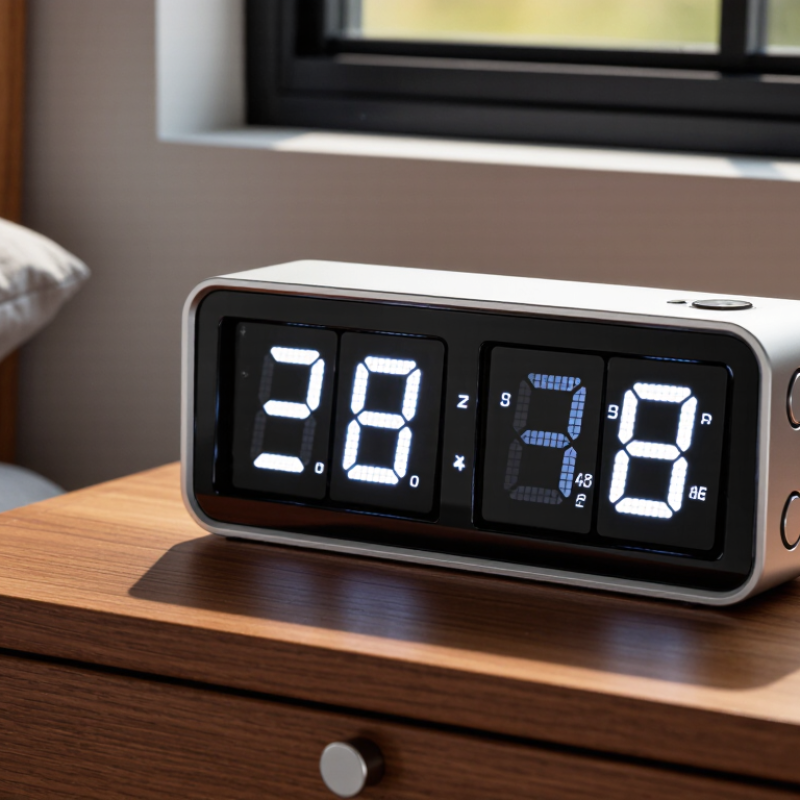
A digital calendar clock displays the time, date, and day of the week on an electronic screen. Many models spell out “Monday” and “September,” reducing the effort needed to interpret numbers. Some also show morning, afternoon, or evening labels. Clarity matters. These details can help older adults and people who find conventional clock faces difficult to read. However, a calendar clock is a practical aid, and its usefulness depends on the individual and the room.
Common types include desktop clocks, wall-mounted displays, and connected models that synchronize time through a network. Basic versions focus on large text and simple controls. Reminder models add scheduled alerts for appointments, meals, or daily routines. Some battery-powered designs use reflective LCD screens, while illuminated displays generally require continuous external power. Placement changes everything. An eight-inch screen may work beside a bed but feel too small across a busy kitchen.
When comparing manufacturers in China, examine sample performance alongside specifications. Check viewing angles, nighttime brightness, button labels, and whether settings survive a power interruption. Memory backup may preserve settings without keeping the screen illuminated, so confirm exactly what “backup” means. Automatic daylight-saving adjustment also deserves testing for the intended market. A crowded display can look informative in photographs yet become confusing during everyday use; removing a feature may sometimes improve usability.
China’s digital calendar clock supply chain is concentrated in coastal electronics manufacturing regions, particularly Guangdong. Shenzhen and Dongguan provide access to display modules, circuit boards, plastic housings, and assembly services. This proximity can simplify component sourcing and prototype revisions. Fujian and Zhejiang also have established clock manufacturing clusters, although individual factories vary considerably in their digital capabilities. Location helps. It does not establish quality, and regional boundaries offer only an approximate guide to supplier capabilities.
The industry includes finished-product manufacturers, contract assemblers, and trading companies that coordinate production through partner factories. Some manufacturers develop firmware and design circuit boards internally. Others purchase standard modules and customize housings, packaging, or screen layouts. Both approaches can suit buyers, depending on customization needs and available engineering support. For calendar clocks, examine weekday readability, automatic dimming, viewing angles, and date retention after power interruptions. A large screen alone is insufficient. Small weekday labels or confusing settings can still make an eight-inch display difficult to use. Supplier descriptions sometimes blur these distinctions, so requests for production evidence should be specific.
Tips: Ask who controls firmware revisions, where assembly occurs, and which checks cover every finished unit. Check samples yourself. Review a working sample in daylight and a dim bedroom, then disconnect and restore power. Request written acceptance criteria covering display defects, time accuracy, and backup behavior. These checks cannot eliminate every production risk, but they make quotations easier to compare.
Evaluating China’s best digital calendar clock manufacturers requires evidence beyond product photos and low quotations. The WHO–UNICEF Global Report on Assistive Technology (2022) estimates that over 2.5 billion people need assistive products. This figure covers many product categories; it does not measure calendar clock demand. Still, it highlights why accessible design deserves attention. Check readability carefully. Request samples showing the full weekday, date, and time from three metres away under ordinary indoor lighting.
Assess manufacturing consistency through documented inspections, component traceability, and clear acceptance criteria. Ask suppliers to demonstrate overnight dimming, power-loss recovery, and date changes across leap years. For bedside models, inspect glare, viewing angles, button labels, and accidental setting changes. Request relevant electrical safety and electromagnetic compatibility reports matching the exact model and intended market. Verify report numbers. ISO 9001 certification supports quality-management assessment, but it does not prove that every clock performs reliably.
Tips: Send each shortlisted factory the same sample checklist and photograph results under identical lighting. Compare minimum order quantities, replacement terms, firmware support, and spare adapter availability alongside unit prices. A large display may still confuse users when abbreviations crowd the screen. There is no universal brightness setting, either. Sample testing remains imperfect: a brief inspection cannot establish years of reliability. Ask for documented failure rates, including the measurement period and number of units shipped.
Comparing digital calendar clock manufacturers in China starts with product range, rather than appearance or catalog size. Some factories specialize in large day-and-date displays for bedside use, while others offer wall clocks and connected models. A broad catalog helps buyers source different formats, but it does not establish manufacturing quality. Details matter. Compare viewing angles, weekday readability, alarm controls, and automatic dimming on actual samples. An eight-inch display may look clear on a desk yet become difficult to read across a bright room.
Technical capabilities deserve closer inspection because similar housings can contain different displays, power circuits, and firmware. Ask whether the manufacturer develops its own software and can adjust date formats, languages, brightness schedules, and alarm behavior. For clocks intended for older adults, test whether settings remain understandable without repeatedly consulting the manual. Request documented power-interruption tests, production inspection records, and compliance reports applicable to your destination market and exact model. Battery backup needs clarification: some designs preserve settings but cannot keep the screen illuminated during an outage. A weakness in this comparison is that sample performance cannot establish consistency across an entire production batch.
Tips: Send each shortlisted factory the same specification sheet and request a sample with your required firmware. Test overnight dimming, unplug the power, and inspect the display from several seated positions. Record the results. Confirm customization charges, minimum order quantities, replacement terms, and whether approved components can change before production.
An anonymous sourcing framework for comparing product ranges, display technologies, and engineering capabilities.
| Manufacturing Specialization | Relevant Product Range | Display and Calendar Functions | Technical Capabilities to Verify | Power and Timekeeping Considerations | Suitable Applications and Key Checks |
|---|---|---|---|---|---|
|
Segment LCD Calendar Clocks
Battery-powered displays |
Desktop calendar clocks, wall calendar clocks, alarm clocks, and indoor temperature clock combinations. | Segmented LCDs can show time, date, weekday, and temperature. Available symbols and character shapes are constrained by the display's segment layout. | LCD segment mapping, microcontroller firmware, calendar logic, button handling, alarm control, and temperature-sensor integration where specified. | Non-backlit LCDs support low-power operation. Backlight use increases consumption. Quartz timekeeping accuracy depends on the oscillator, temperature, and circuit design. | Suitable for desks and household use. Check viewing angles, contrast, calendar rollover, alarm operation, and measured battery life. |
|
LED Calendar Wall Clocks
Illuminated digits |
Large-digit wall clocks, date-and-time displays, and calendar clocks with temperature readouts. | Emissive LED digits remain visible in darkness. Date, weekday, and temperature presentation depends on the display layout. | LED driver design, multiplexing, brightness adjustment, thermal management, and remote-control integration where offered. | Continuous illumination generally requires more power than a non-backlit segment LCD. Some designs use backup power to retain time while the main display is off. | Suitable for offices and shared indoor spaces. Check readability at the intended distance, minimum brightness, flicker, and behavior after power loss. |
|
Full-Text Calendar and Day Clocks
Care-oriented interfaces |
Day-and-date clocks, multilingual calendar displays, and reminder clocks intended for home or care settings. | Pixel-addressable screens can display full weekday names, written dates, time-of-day labels, and reminder messages. | User-interface development, font rendering, language localization, reminder scheduling, automatic dimming, and recovery after interrupted power. | Backlit screens generally require continuous power. Retaining the time does not necessarily mean the screen or reminder audio will operate during an outage. | Suitable where clear day-and-date information is useful. Check text size, contrast, language quality, reminder behavior, and ease of setup with intended users. |
|
Radio-Controlled Calendar Clocks
Regional time signals |
Automatically synchronized desktop and wall clocks with calendar displays. | LCD or other display technologies can present time and calendar information derived from a supported radio time signal. | Receiver and antenna integration, signal decoding, reception scheduling, manual fallback, and daylight-saving behavior for the intended region. | Reception depends on the supported service, location, interference, and building conditions. Examples of regional services include DCF77, WWVB, and JJY. | Suitable within the relevant signal's usable coverage. Verify the exact supported service and frequency; “radio-controlled” does not imply worldwide compatibility. |
|
Wi-Fi Calendar Clocks
Network time synchronization |
Connected calendar clocks, configurable information displays, and clocks with remote settings or reminders where implemented. | Pixel-addressable displays can combine time, date, and configurable content. Network time synchronization and content delivery are separate functions. | Wi-Fi provisioning, NTP or SNTP integration, time-zone rules, offline operation, firmware updates, and security maintenance. | Time synchronization requires access to a reachable time server. Continued timekeeping during network loss depends on the local clock implementation. | Suitable where automatic synchronization is useful. Check supported Wi-Fi bands, setup requirements, cloud dependencies, update support, and offline behavior. |
|
E-Paper Calendar Clocks
Reflective displays |
Low-power desk calendars, date-focused displays, and digital clocks designed around infrequent screen updates. | E-paper retains a static image without continuous display-driving power. Readability relies on ambient light unless a separate light source is provided. | Display waveform integration, partial-refresh handling where supported, ghosting management, sleep modes, and refresh scheduling. | Total consumption depends on refresh frequency, wireless activity, and other electronics. Image retention alone does not establish battery life. | Suitable for date-focused displays and low-power designs. Check refresh speed, residual images, operating temperature, and suitability for minute or second updates. |
Choosing digital calendar clock manufacturers in China requires evidence of production capability, especially when ordering customized products. OEM services may cover larger date displays, multilingual menus, automatic dimming, enclosure colors, and branded packaging. Specify viewing distance, character height, power adapters, and backup settings before requesting quotations. Request physical samples. A screen that looks sharp in photographs may become difficult to read from an angle. For bedside use, check whether minimum brightness remains comfortable in a dark room.
Quality documents deserve careful inspection because factory management certificates and product compliance reports serve different purposes. ISO 9001 certification covers quality management systems; it does not establish that every clock meets destination-market requirements. Ask for model-specific test reports and confirm that the tested adapter matches your proposed configuration. Depending on the destination and design, relevant requirements may include electrical safety, electromagnetic compatibility, and restricted substances. Verify report numbers. Check the issuing laboratory, model identifiers, test dates, and scope rather than accepting certificate images alone.
Supplier selection should also examine minimum order quantities, tooling ownership, firmware support, and replacement procedures. Ask how workers inspect missing display segments, incorrect weekdays, and settings retention after power interruptions. Agree on defect definitions and inspection sampling before paying a production deposit. A small pilot order can reveal packaging damage or confusing controls, although it cannot establish long-term reliability. Customization is not always beneficial: extra menu options may make a calendar clock harder to use. Leave time to revise the sample if readability or setup proves disappointing.